
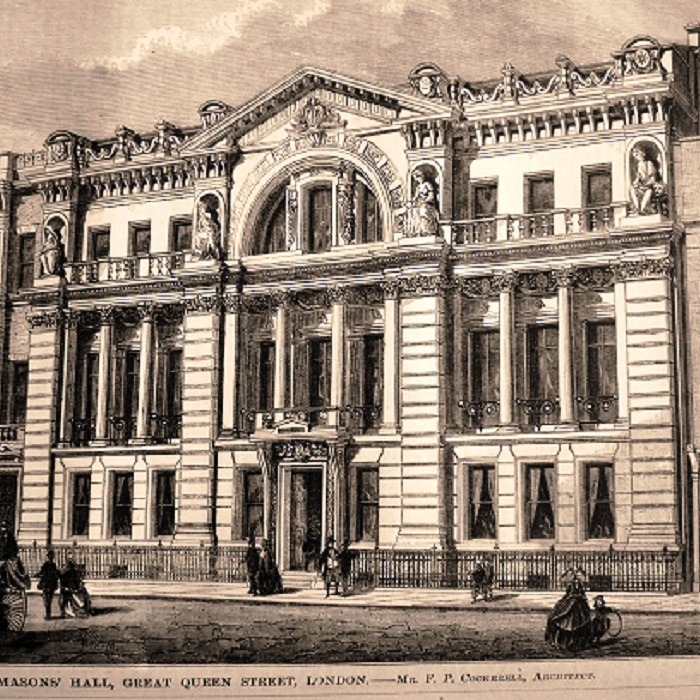
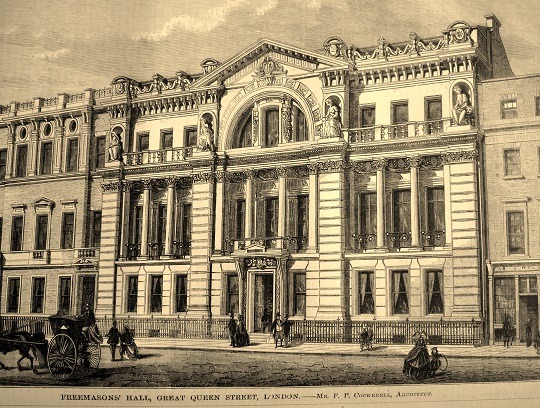
Pen and Ink drawing of the 1869 Freemasons’ Hall
As both a Metropolitan and Middlesex Mason, I am interested in how the two Provinces corelate, especially how that which might first appear a paradox actually isn’t, or is it? How could Freemasons’ Hall be in Middlesex when everybody knows it is in London? This is certainly one for the Province’s historians who will explore the growth of London as it extended its boundaries into Middlesex’s fair fields of market gardens, wheat and pleasant countryside.
Strictly, the area of St Paul’s, Covent Garden was one of nine parishes in the Liberty of Westminster, which was essentially Middlesex. Great Queen Street would have been in this parish. The formation of Middlesex County Council and the transfer of areas which became known as the London County Council would not take place for another 20 years. Indeed, the new Freemasons’ Hall preceded the establishment of the Provincial Grand Lodge of Middlesex by about a year. However, if you are not an historian per se, but interested in the development of Freemasons’ Hall, the following, hopefully, will contribute to a daily advancement in masonic knowledge.
The Quest for a New Hall –
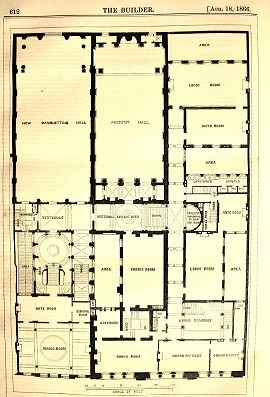
Floor plans for FMH as published in The Builder, August 1866
Born in Middlesex –
Born at Eaton Square in Belgravia, Westminster in the County of Middlesex in March 1833, Frederick Pepys Cockerell was the third son of Charles Robert Cockerell a distinguished architect and first recipient of the prestigious Gold Medal of the Royal Institute of British Architects in 1848. Frederick entered Winchester College in 1845 as a Commoner or fee payer having failed to obtain a scholarship. He spent three years at Winchester making steady progress in the Classics which was how the boys were assessed before moving on to the next class. However, he did not win any prizes. Nevertheless, it appears he did reasonably well in any event. He then enrolled in Kings College London on 4th October 1848 at the age of 15. Records show that his parent or guardian was given as Chas. Robt. Cockerell, Architect of Hampstead North End. The entrance paper was completed and the sum of £28.14s was paid as fees for two terms and he was admitted to the Department of Applied Sciences. Frederick’s name appears on the College calendars for 1849-50 and 1850-51. After leaving Kings College he had pupillage with a number of architects and after completing a study tour of the major Italian Cities returned to England in 1856 to work in his father’s architectural office in Liverpool. Before then in 1854 he had become a pupil of Philip C Hardwick R A who would later provide testimony as to his architectural abilities.
Masonically Speaking –
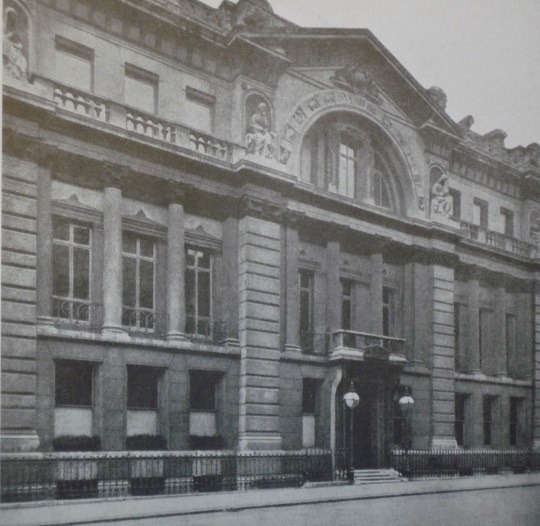
Freemasons’ Hall of 1869 – an early photo
Cockerell was the winner and relatively young being only 33. This did in some way cause an impediment but he managed to secure testimonies from leading members of the architectural profession as to his prowess and knowledge. However, in the meantime he was ushered into Westminster and Keystone Lodge No 10 where he was initiated on the 13th April 1863, Passed on 11th June and Raised on 8th July. Once he had become a Freemason in the April he was appointed Grand Superintendent of Works in the same month. He was subsequently exalted into the Royal Arch in Westminster and Keystone Chapter No 10 in 1866.
A Stately and Superb Edifice
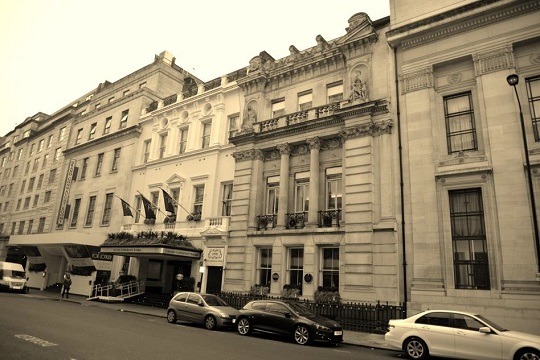
Great Queen Street today with a remnant of the front façade of Cockerell’s Freemasons’ Hall still visible next to the Connaught Rooms entrance (photo – Stan Marut).
The Inauguration –
The new Hall was inaugurated on the 14th April 1869. The purpose of the new Grand Lodge was to include “good offices for our charities, a handsome boardroom for our meetings, convenient Lodge rooms for our Lodges, a grand banqueting hall for our social gatherings and a restored temple more worthy of our sacred rites”.
To The Grand Lodge Above –
During this extremely busy period in his life, he married Mary Mulock of Bellair, Kings County (now County Offaly) in Ireland. Mary was the seventh child of fourteen and had been married and widowed before she met Frederick. However, they were married on the 20th July, 1867 at St James Piccadilly. They had five children. His death was somewhat a tragedy Mary having just given birth to their fifth child. On his visit to Paris in November 1878, representing the interests of the Royal Institute of British Architects, he died suddenly. The remnant of the 1869 Grand Lodge building is testimony to an outstanding architect of his time and a reminder of the history not only of London masonry, but also the history of Grand Lodge at that great time of Empire. His early passing was deeply regretted. An article in Freemasons Chronicle dated December 21st, 1878 stated that ,“the loss of one who had so highly distinguished himself in the profession of architecture, as well as in the science of Free and Accepted or Speculative Masonry must be, and is, deeply lamented by the whole of the English Craft….”
A Moot Point –
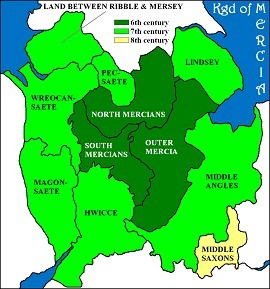
Middle Saxons in the wider context .
Source: By TharkunColl (talk) (Uploads) – I TharkunColl (talk) (Uploads) created this image., CC BY-SA 3.0, https://en.wikipedia.org/w/index.php?curid=13774750
Images of Frederick Pepys Cockerell as well as additional biographical details may be found using the following links:
https://sculpture.gla.ac.uk/view/person.php?id=msib5_1246023238
https://www.royalacademy.org.uk/art-artists/work-of-art/frederick-pepys-cockerell-1833-1878
https://www.architecture.com/image-library/ribapix/image-information/poster/frederick-pepys-cockerell/posterid/RIBA5825.html
Share this Post
